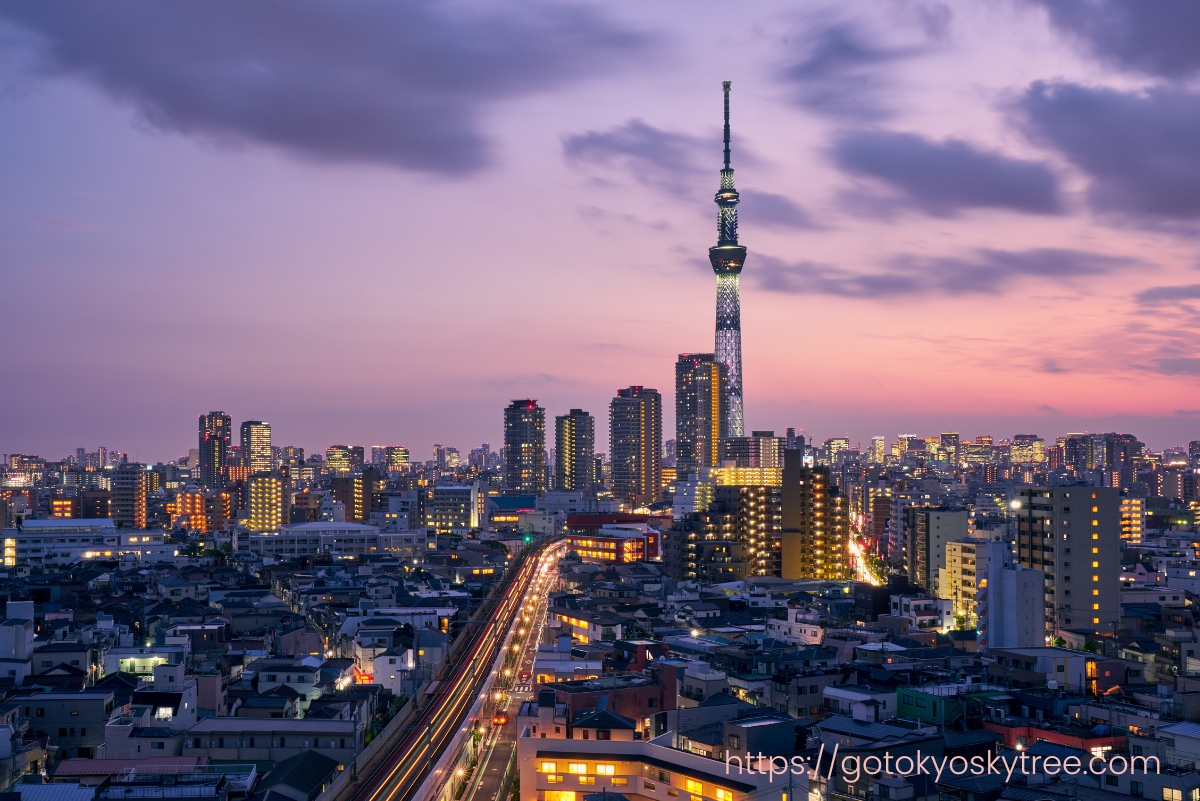
Tokyo Skytree at Night: Lighting Colors, Best Time Slots & Night Views
Short answer: yes — night is arguably the best time for Tokyo Skytree. And “Skytree at night” is really two different experiences. One is standing on the observation decks 350 or 450 meters up, watching Tokyo turn into an endless grid of light. The other is standing on the ground looking up at the tower itself, lit in one of its signature LED designs. This guide covers both, plus the one booking trick that lets you get daylight, sunset, and the night city in a single visit.
The lighting designs: Iki, Miyabi, and Nobori
The tower’s LED illumination rotates between three named designs, each rooted in the neighborhood’s Edo heritage:
- Iki — a pale, cool blue centered on the tower’s core pillar, inspired by the waters of the Sumida River that flow right past the base. It reads as calm and crisp, and it’s the design most people picture when they think of Skytree.
- Miyabi — Edo-purple (a traditional bluish violet), draped over the steel lattice like fabric. It stands for elegance, and it photographs beautifully in reflections.
- Nobori — the newest of the three, an auspicious tangerine-orange with slow vertical movement meant to evoke festival banners being raised. It’s the warmest and most festive of the set.
One design is shown per evening, alternating day by day, so which color you get is partly luck. Seasonal and collaboration lightings (anime tie-ins, holidays, special events) regularly replace the standard three, so check the official site’s lighting schedule if a specific color matters to you. Lighting-up time shifts with sunset — roughly 4:30 pm in midwinter, closer to 7:00 pm in midsummer — and the lights go off at midnight.
The sunset-to-night strategy
The single best booking move: reserve a timed-entry slot 45–60 minutes before sunset. You’ll ride up in daylight, watch golden hour wash over the city, catch the brief blue-hour window when Tokyo’s lights switch on against a still-glowing sky, and then get the full night panorama — three distinct views on one ticket. Tokyo Tower, Shinjuku’s skyline, and on clear evenings the silhouette of Mt. Fuji all fade in and out of the show.
A few practical notes:
- Weekday evenings are noticeably quieter than weekends. If your itinerary allows, aim for Tuesday–Thursday.
- Watch last admission. On the typical schedule the decks run 10:00 am–10:00 pm with last admission at 9:00 pm. But hours are seasonal — in summer 2026 some dates have run 9:00 am–10:30 pm with last admission at 9:30 pm. Always confirm the day’s hours on the official site (en.tokyo-skytree.jp) before locking in a late slot.
- Sunset in Tokyo ranges from about 4:30 pm in December to about 7:00 pm in late June — set your slot accordingly.
For which ticket to buy — Tembo Deck only vs. the combo with the higher Tembo Galleria — see our tickets and combos guide and the deck-by-deck comparison. If you’d rather have the evening organized for you, there’s an Asakusa night tour that includes Skytree tickets — temple district after dark first, tower views second.
Night photography from the decks
The enemy at night is not darkness — it’s reflections. The decks are fully glazed, and the interior lighting bounces your own silhouette, phone screen, and half the gift shop back into every frame. What works:
- Press the lens close to the glass. The nearer you are, the less interior light sneaks into the shot.
- Block stray light with your free hand, a jacket sleeve, or a dark scarf cupped around the lens.
- No tripods — they’re not allowed on the decks, an established house rule. Brace your elbows on the rail or use a strap pulled taut instead, and lean on night mode.
- Shoot during blue hour if you can; the sky still has color and the contrast is far easier to expose than full black.
Seeing the lit tower from outside
The illuminated tower is free to enjoy, and the Sumida River side gives you the classics:
- Jukken-bashi Bridge — about a 10-minute walk from the tower, and the signature shot: the “upside-down Skytree” reflected in the canal. The relatively dark surroundings make the reflection pop.
- Sumida Park — along the river on the Asakusa side; in spring you can frame the lit tower behind cherry blossoms.
- Azumabashi Bridge — about 6 minutes from Asakusa Station, with a wide view of the glowing tower over the Sumida River.
For a full walking route with more angles, see our area photography spots guide.


Traveler photos from the Asakusa night tour listing on GetYourGuide.
Book it
Timed-entry slots around sunset sell out first, especially Friday–Sunday. Lock yours in with a Skytree admission e-ticket, aim for 45–60 minutes before sunset, and let the city do the rest.
Ready to Visit Tokyo Skytree?
Book your skip-the-line tickets now and experience breathtaking views of Tokyo!
Book Tickets Now