Is Tokyo Skytree Worth It? What I Wish I'd Known Before Going
Here’s the thing nobody tells you before you go: Tokyo Skytree is a mediocre errand but a great neighborhood.
Treat it as a checkbox — ride 40 minutes across town, queue, go up, look, come down, ride 40 minutes back — and you’ll file it under “fine, I guess,” next to every other big-city observation deck you’ve ever done. Treat it as the anchor of an east-Tokyo day, and it becomes one of the best-organized sightseeing days in Japan. The tower didn’t change between those two sentences. Your plan did.
This is the page I wish someone had shown me first: who should genuinely skip it, who should cross town for it even alone, what turns a decent visit into a great one, and where the tower honestly ranks — in Tokyo, and on its own street.
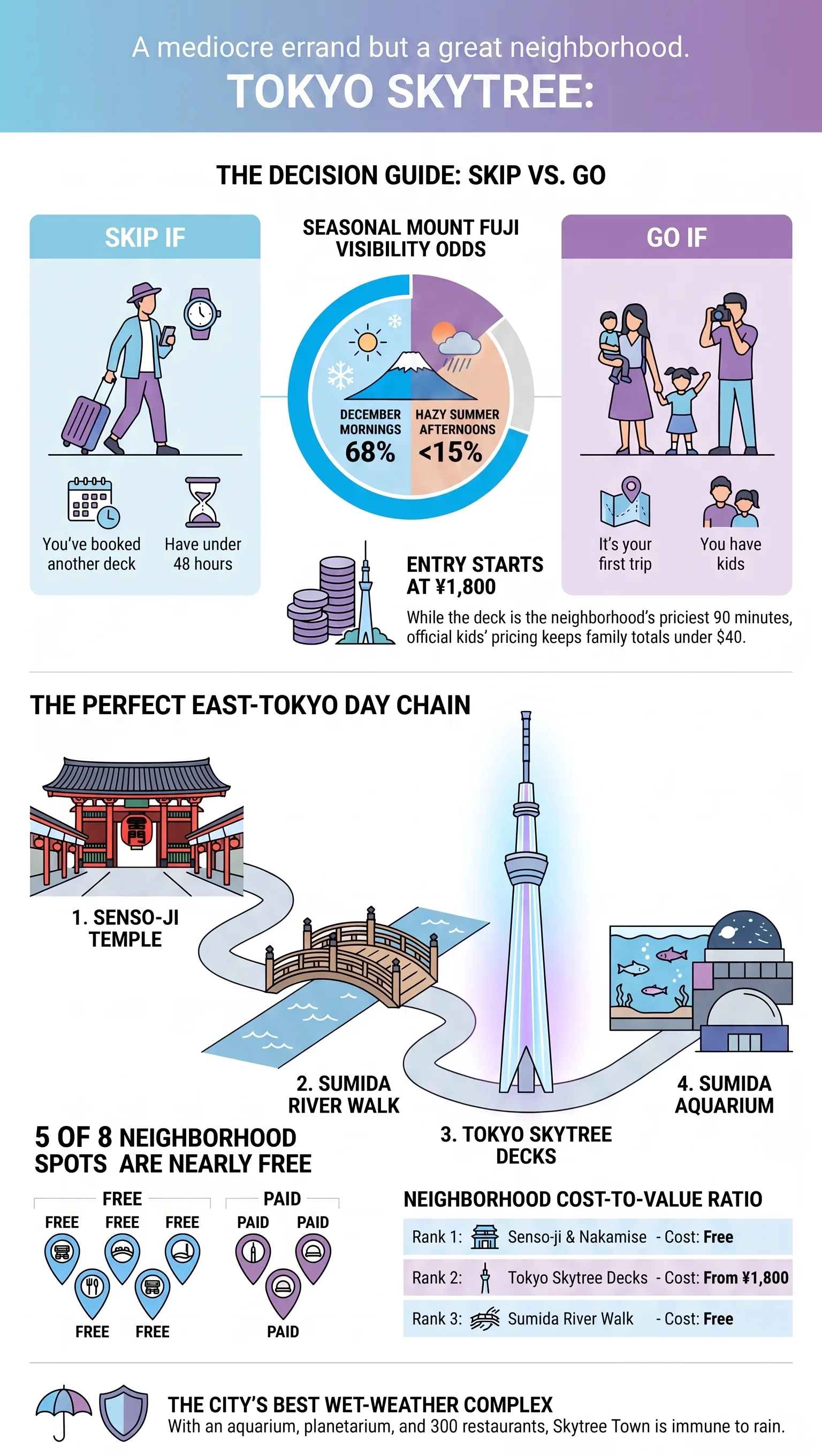
The decision, in one image — the full reasoning follows below.
The mistake: treating Skytree as a standalone POI
Skytree stands in Sumida, on Tokyo’s east side — the old shitamachi (low city), a district of temple smoke, river bridges, and small workshops that predates every skyscraper you can see from the deck. It is not near the Tokyo most first-timers stay in. From Shinjuku or Shibuya you’re looking at 35-45 minutes each way; that’s a half-day of transit wrapped around a 90-minute attraction.
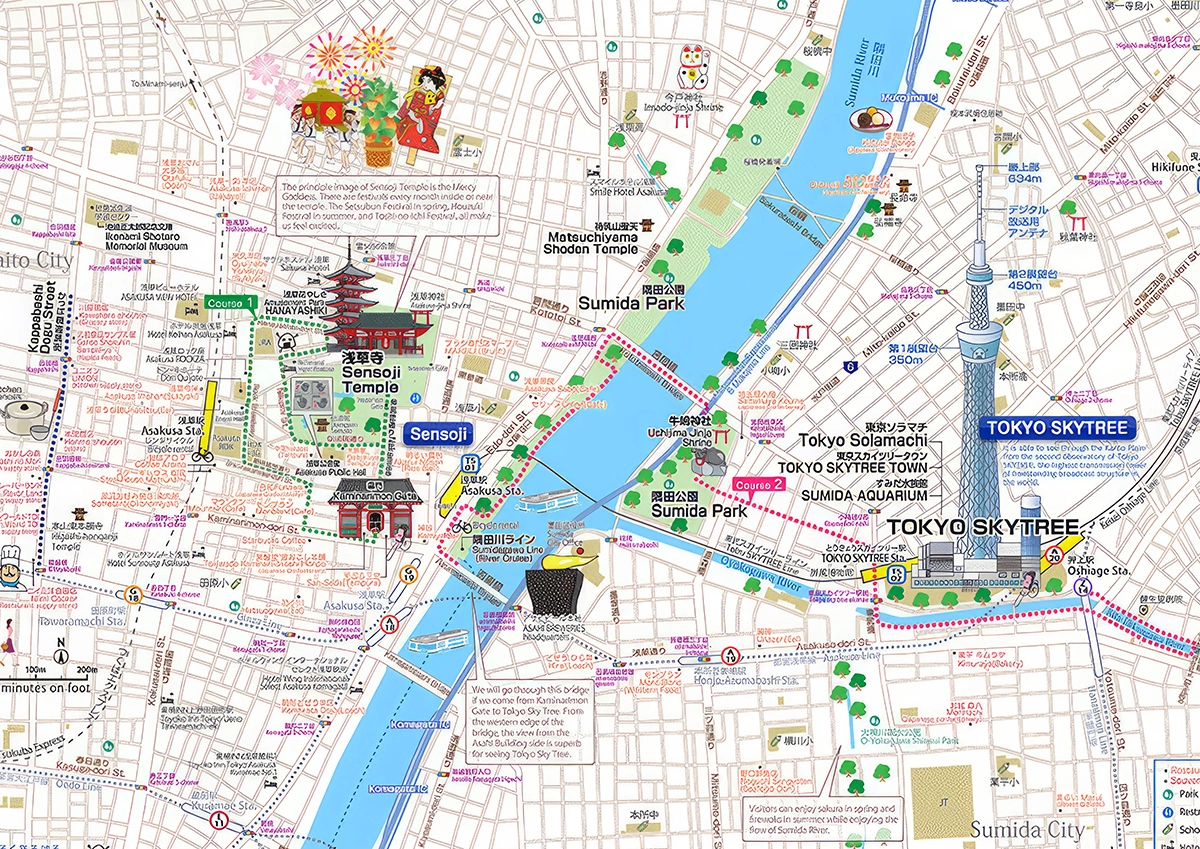
But here’s what the transit math misses: the tower sits a 15-25 minute riverside walk from Senso-ji, Tokyo’s oldest and most-visited temple, connected by the Sumida River Walk and the Mizumachi cafe strip. The complex under the tower contains an aquarium, a planetarium, a ¥300 postal museum, and 300 restaurants. Two stops south is Ryogoku, the sumo capital of the planet. In other words: the question was never “is the tower worth 90 minutes,” it’s “is east Tokyo worth a day” — and that answer is yes for almost everyone.


Traveler photos from the Asakusa history tour listing on GetYourGuide.
Skip it (honestly) if you’re this person
- You’ve already booked another observation deck this trip. Deck fatigue is real. If Shibuya Sky or Tokyo Tower is on your itinerary, a second aerial view of the same city has steeply diminishing returns — our Tokyo Tower vs Skytree and Shibuya Sky vs Skytree comparisons exist precisely to make you pick one. (If the pick does go the other way, Tokyo Tower’s official e-ticket books the same way — and we answer the same worth-it question for Tokyo Tower with the same honesty.)
- It’s a hazy July afternoon and your secret motive is Mount Fuji. In summer the mountain shows on roughly 1 day in 8, mostly before 8 a.m. Buying an afternoon deck ticket for a Fuji photo in August is a lottery ticket, not a plan.
- You have 48 hours in Tokyo and you’re staying west. With two days, the round-trip transit is too expensive in the only currency that matters — daylight. Shibuya Sky is ten minutes from where you already are; spend your east-Tokyo half-day allowance on Senso-ji at dawn instead.
- You just don’t care about views from towers. Legitimate position. The district still wants you (see the ranking below); the elevator doesn’t.
Cross town for it — even alone — if you’re this person
- It’s your first time in Tokyo and the city hasn’t “landed” yet. No street-level experience communicates what Tokyo is — a city that continues to every horizon, in every direction, without thinning — like the 350-meter deck does. First-timers gasp. Fifth-timers check their watch. Be a first-timer here.
- You’re traveling with kids. This is Tokyo’s best self-contained family day, full stop: deck + aquarium + Solamachi food floors + a ¥300 stamp museum, all stroller-friendly, all under one roof, immune to weather. Official kids’ pricing (6-14 half, under-6 free) keeps the family total under $40 for the deck itself.
- You’re an engineering person. The world’s tallest tower stands in one of the world’s most seismic capitals because of a central-column damping system adapted from thousand-year-old pagoda design. The tower is the exhibit.
- You’re a photographer with a clear winter morning. December-February mornings deliver Fuji-behind-Tokyo frames and, twice a year, Diamond Fuji. This is the season the deck was built for.
- It’s raining. Skytree Town is the strongest wet-weather complex in the city. The night deck doesn’t even need clear skies — city lights work in drizzle.
To get more value: do, book, arrange
- Anchor it to Asakusa. Temple at 8:00, riverside walk, Solamachi lunch, deck in the early afternoon — the full hour-by-hour itinerary. This single decision doubles the day’s value at zero cost.
- Book the sunset slot on a weekday. Daylight, golden hour, and the lit-up city on one ticket. Weekends, book the morning instead and give the evening to Asakusa’s lantern-lit lanes.
- Decide deck vs combo before you’re in the queue. The ticket math is here: the e-ticket markup is about a dollar, the combo adds the Galleria for enthusiasts, and the guided tiers buy narration, not a better view.
- Check a live Fuji cam the morning of. Thirty seconds that decides whether to rush the early slot or relax into the afternoon.
- Go early in your trip. Weather cancels views; an early-trip visit leaves reschedule room. (The same logic our helicopter-and-decks readers know well.)
Where Skytree honestly ranks in Tokyo
Among the city’s heavyweight sights, here’s our honest tier list for a first visit: Senso-ji, Shibuya Crossing, Meiji Shrine, and Tsukiji’s outer market are the untouchable top tier — free, unduplicated anywhere on earth, no booking required. Skytree sits at the top of the second tier: as a standalone errand it’s a top-ten Tokyo sight; bundled into the east-Tokyo day it climbs to top-three, because it’s the only entry on the list that comes packaged with a temple, a river, an aquarium, and dinner.
Ranking the neighborhood: what’s actually around it
If your east-Tokyo day has limited slots, spend them in this order:
| Rank | Spot | Walk/hop from Skytree | Cost | The honest one-liner |
|---|---|---|---|---|
| 1 | Senso-ji & Nakamise | 20 min walk | Free | The temple outranks the tower. Go at 8:00 or after dark. |
| 2 | Tokyo Skytree decks | — | from ¥1,800 | The scale-of-Tokyo machine. Best deck value in the east. |
| 3 | Sumida River Walk + Mizumachi | 10 min | Free | The connective tissue that makes 1 and 2 one outing. |
| 4 | Sumida Aquarium | in the complex | ¥2,700 | Best rainy-day and with-kids upgrade in the district. |
| 5 | Ryogoku sumo district | ~10 min by train | varies | Two stops south: the Kokugikan sumo arena and its museums. Tournament weeks (January, May, September) vault this to #2. |
| 6 | Samurai & Ninja Museum, Asakusa | 20 min walk | varies | The hands-on history hit — see the Samurai Ninja Museum guide for the Asakusa experience. |
| 7 | Kappabashi Kitchen Street | 25 min walk | Free to browse | Where Tokyo’s chefs buy knives and fake food. The souvenir street for people who hate souvenir streets. |
| 8 | Postal Museum & planetarium | in the complex | ¥300 / ¥1,500+ | The fillers that turn a gap in the schedule into a story. |
The ranked spots on the map: red is the tower, green markers are free, gold are ticketed. Tap a marker for the guide link.
The pattern worth noticing: five of the eight cost little or nothing. The east-Tokyo day is the cheapest great day in the city — the tower is simply its most expensive 90 minutes, and the only part you need to book ahead.
The verdict, compressed
Skip if: second deck of the trip, hazy-day Fuji hopes, 48-hour trip based west, or towers just aren’t your thing. Go — even alone — if: first Tokyo trip, kids in tow, engineering brain, clear winter morning, or rain. Either way: never do the tower without the neighborhood. The elevator is 60 seconds; the district is the day.
Ready to Visit Tokyo Skytree?
Book your skip-the-line tickets now and experience breathtaking views of Tokyo!
Book Tickets Now